
If you are planning an insulation project for your home, you have likely hit the biggest fork in the road: Should you stick with traditional fiberglass or upgrade to spray foam?
It is the most common question we get.
Many contractors will push you toward the one product they sell. But here is the truth: We install both. We believe both materials have their place in modern construction, depending on your budget, your goals, and the specific area of the house you are insulating.
In this guide, we will give you an unbiased, side-by-side comparison of Spray Foam vs. Fiberglass so you can make an educated decision for your project.
The Contenders at a Glance
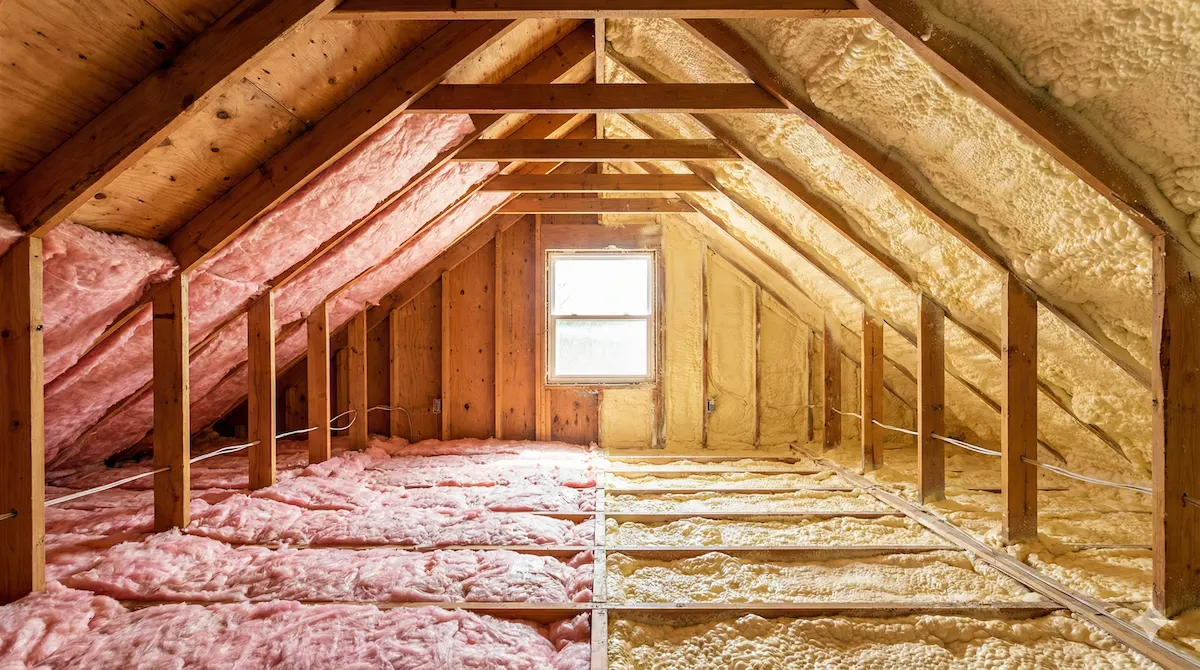
Before we talk about which is “better,” let’s define how they work.
Fiberglass: The industry standard for decades. It works by trapping pockets of air within spun glass fibers to slow down heat transfer. It’s like a thick wool blanket for your house.
Spray Foam: A modern chemical mixture that expands upon application. It hardens to fill the cavity completely. It acts not just as insulation, but as an air barrier (like a windbreaker).
Fiberglass Insulation: The Cost-Effective Standard
Fiberglass is still the most popular insulation in North America for a reason. When installed correctly by professionals, it is a reliable and safe product.
The Pros:
Affordability: It is significantly cheaper upfront than spray foam. If you are on a tight budget, fiberglass allows you to insulate your home without breaking the bank.
DIY Friendly: For small projects, fiberglass batts are easier to handle.
Great for Sound: Fiberglass batts are excellent at dampening sound between interior walls (e.g., between a bedroom and a bathroom).
The Cons:
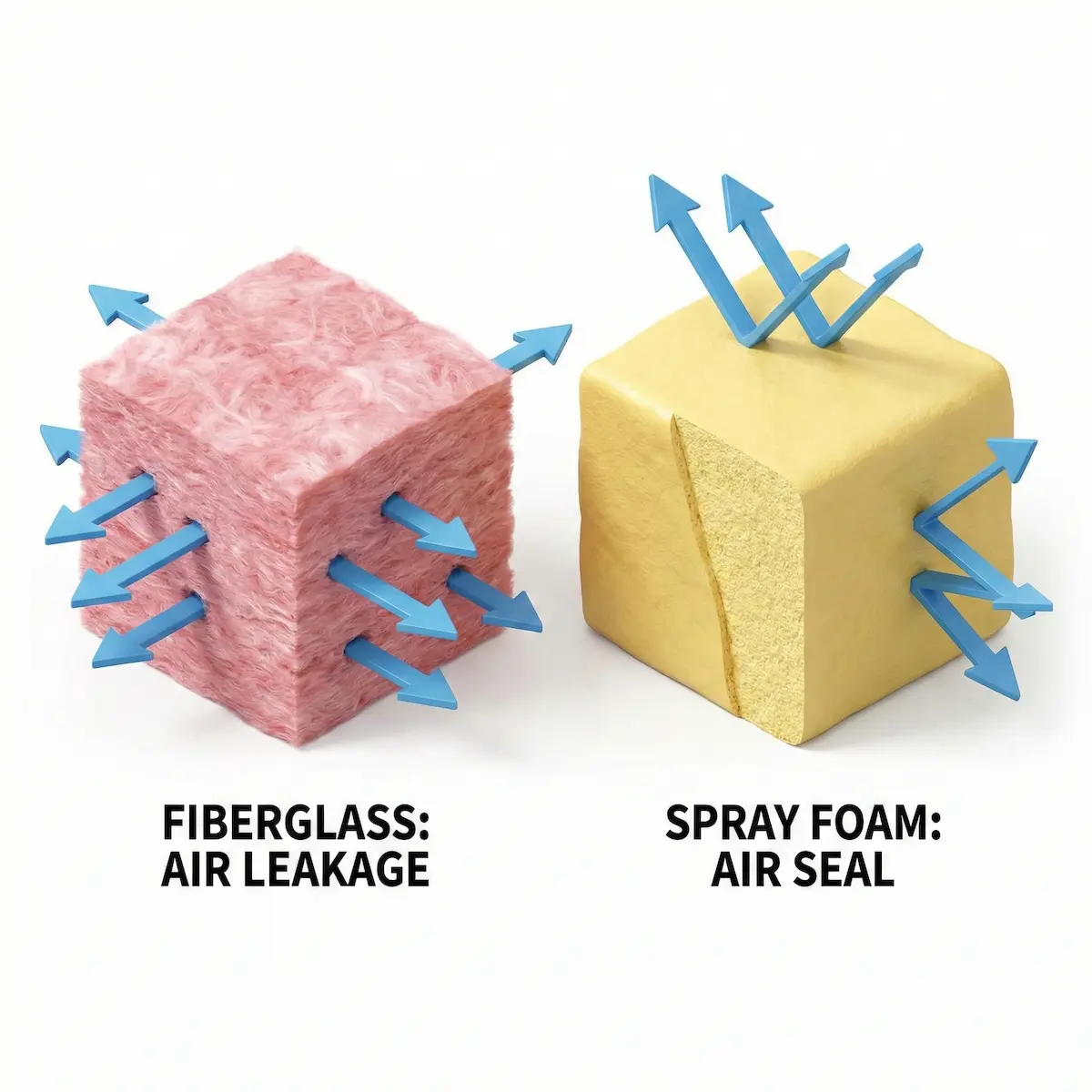
Air Leakage: This is the big one. Fiberglass filters air; it doesn’t stop it. If your home has drafts, fiberglass won’t stop the wind from passing through it, which reduces its effective R-value.
Moisture Sensitivity: If it gets wet due to a leak or condensation, it can sag and lose its insulating ability.
Best Use Case: New construction on a budget, interior walls for soundproofing, or attics where proper air sealing has already been done separately.
Spray Foam Insulation: The Performance Upgrade
Spray foam is often considered the “gold standard” in building science today. It solves the biggest weakness of traditional insulation: air movement.
The Pros:

Total Air Seal: It expands to fill every crack, gap, and crevice. It stops drafts, keeps allergens/pollen out, and prevents conditioned air from escaping.
Energy Efficiency: Because it air-seals, homeowners typically see higher energy bill savings compared to fiberglass. Click here to our article “Is Spray Foam Worth It?”
Structural Integrity: Closed-cell foam becomes rigid and can actually add strength to your walls and roof deck.
Longevity: It doesn’t settle, sag, or degrade over time.
The Cons:
Cost: It is a premium product with a higher upfront investment.
Requires Pro Installation: This is not a DIY job. It requires complex machinery and trained chemistry experts to apply safely.
Best Use Case: Attics, crawlspaces, rim joists (where most air leaks happen), and homeowners looking for maximum long-term energy savings.
Head-to-Head Comparison
| Feature | Fiberglass Insulation | Spray Foam Insulation |
| Upfront Cost | Low ($) | High ($$$) |
| Air Sealing | Poor (Requires separate sealing) | Excellent (Built-in) |
| Lifespan | 15-20 Years (May settle) | 80+ Years (Permanent) |
| Moisture Control | Absorbent (Can hold water) | Resistant (Closed cell rejects water) |
| Sound Control | Excellent | Good |
The “Hybrid” Solution (Flash and Batt)
Can’t decide? Sometimes you don’t have to.
Because we are experts in both materials, we often recommend a technique called “Flash and Batt.”
This involves applying a thin layer of closed-cell spray foam (1-2 inches) to create an airtight seal against the exterior sheathing, and then filling the rest of the wall cavity with affordable fiberglass batts.
This gives you the air-sealing benefits of foam with the cost savings of fiberglass. It is a smart middle-ground strategy that many “foam-only” contractors won’t tell you about.
Conclusion: Which One Should You Choose?
The “right” insulation depends on what you value most right now:
Choose Fiberglass If: You have a strict upfront budget, you are insulating interior walls for sound, or you are looking for a standard code-compliant solution.
Choose Spray Foam If: You plan to stay in the home for a long time, you want to permanently fix cold/hot rooms, and you want the lowest possible monthly energy bills.
Still not sure which fits your project?
We can help. Since we sell and install both, we won’t pressure you. We will simply assess your home and give you the options.
About the Author: Kevin Delcid has extensive experience in the insulation industry, specializing in building science and energy efficiency solutions. Like owner of Alpha Spray Foam Insulation LLC has overseen thousands of successful spray foam installations across residential and commercial properties.